
Introduction
One of the most common—and emotionally charged—claims about religion is that it makes people more moral. For centuries, moral behavior has been framed as inseparable from faith, while atheism and secularism have often been portrayed as moral voids.
But when this assumption is examined scientifically, an uncomfortable reality emerges: morality does not belong exclusively to religion—and never has.
Modern psychology, sociology, and neuroscience have spent decades studying moral behavior across cultures, belief systems, and levels of religiosity. Their findings challenge both religious certainty and simplistic secular narratives.

This article explores what science actually says about religion and morality: whether faith truly improves moral behavior, how morality forms in the human brain, and why belief systems may shape who we treat morally—rather than how moral we are.
The Traditional Claim: Morality Comes From God
Most religions assert that:
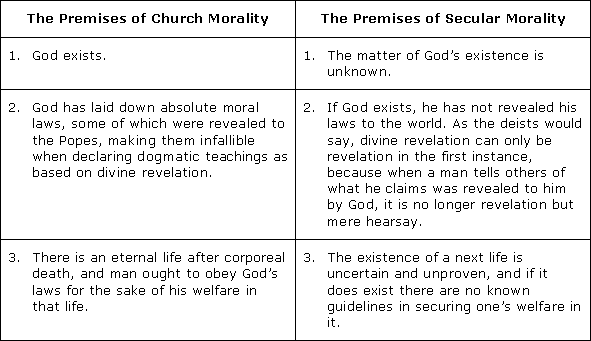
- Moral laws originate from divine authority
- Without belief in God, morality collapses
- Fear of divine punishment enforces ethical behavior
This framing positions religion as the guardian of moral order and casts non-belief as inherently dangerous.
But this claim raises a fundamental question:
If morality depends on religion, why do moral instincts appear in every human society—including non-religious ones?
Morality Before Religion: An Evolutionary Perspective
From an evolutionary standpoint, morality predates organized religion.
Humans evolved as social animals. Survival depended on:
- Cooperation
- Trust
- Fairness
- Punishment of cheaters
These traits appear in:
- Infants (before religious exposure)
- Non-religious cultures
- Other social species
Morality emerged as a biological and social adaptation, not a theological invention.
Religion later formalized and codified these instincts—but did not create them.
Read “The Positive Impact of Religion on Society: Morality, Community, and Purpose”
What Psychology Reveals About Moral Behavior
Moral Intuition Comes First
Research shows that humans make moral judgments intuitively, not rationally.
We feel something is right or wrong before we justify it.
Religion often supplies the justification—but the moral impulse comes first.
Religion and In-Group Morality
Studies consistently find that religion:
- Strengthens morality within groups
- Increases generosity toward fellow believers
- Reinforces loyalty and obedience
But it does not reliably increase universal compassion.
In some cases, strong religious identity correlates with:
- Reduced empathy for outsiders
- Increased moral exclusion
- Justification of harm to “non-believers”
Religion sharpens moral boundaries—it does not necessarily expand them.
Does Fear of Punishment Improve Morality?
Fear-based morality is effective—but limited.
Religious punishment (hell, judgment, sin) can:
- Increase compliance
- Reduce certain behaviors
- Encourage conformity
However, fear-driven morality:
- Weakens internal ethical reasoning
- Encourages moral shortcuts
- Fails when authority is absent
People behave morally when watched, not necessarily when they understand why morality matters.
Secular Morality: Does It Work?
Highly secular societies challenge the claim that religion is required for morality.
Countries with low religious participation often show:
- Low crime rates
- High social trust
- Strong ethical norms
- Robust legal institutions
These societies rely on:
- Empathy
- Education
- Social accountability
- Rule of law
Morality shifts from divine enforcement to collective responsibility.
Religion, Hypocrisy, and Moral Licensing
One of the most uncomfortable findings in moral psychology is moral licensing.
When people believe they are morally “good,” they may feel justified in:
- Acting selfishly
- Judging others harshly
- Excusing harmful behavior
Religious identity can amplify this effect:
“Because I believe correctly, my actions are justified.”
This does not make believers immoral—but it undermines the claim of moral superiority.
Why Religion Feels Like It Creates Morality
Religion feels morally powerful because it:
- Provides clear moral language
- Offers certainty instead of ambiguity
- Reduces moral anxiety
- Reinforces identity
Clarity feels like virtue—even when outcomes are mixed.
The Dangerous Question: Is Morality Better Without God?
Science suggests a more nuanced answer:
- Morality does not require belief in God
- Religion can reinforce moral behavior in some contexts
- It can also distort moral judgment in others
The issue is not belief—but how belief structures moral boundaries.
Morality as a Human Capacity, Not a Religious Gift
Morality emerges from:
- Empathy
- Social learning
- Cultural norms
- Cognitive development
Religion can nurture these capacities—or override them.
When belief encourages compassion, morality expands.
When belief enforces exclusion, morality contracts.
Conclusion: Science Rejects the Monopoly on Morality
The evidence is clear: religion does not own morality.
Faith can support ethical behavior—but it can also distort moral judgment in others. Moral instincts arise from human nature, shaped by culture and reinforced by institutions—religious or secular.
The real danger lies not in believing—but in believing that morality belongs exclusively to one worldview.
A society that understands morality as a shared human responsibility is more ethical than one that delegates it to divine authority alone.
2 thoughts on “Does Religion Make People More Moral? What Science Says”